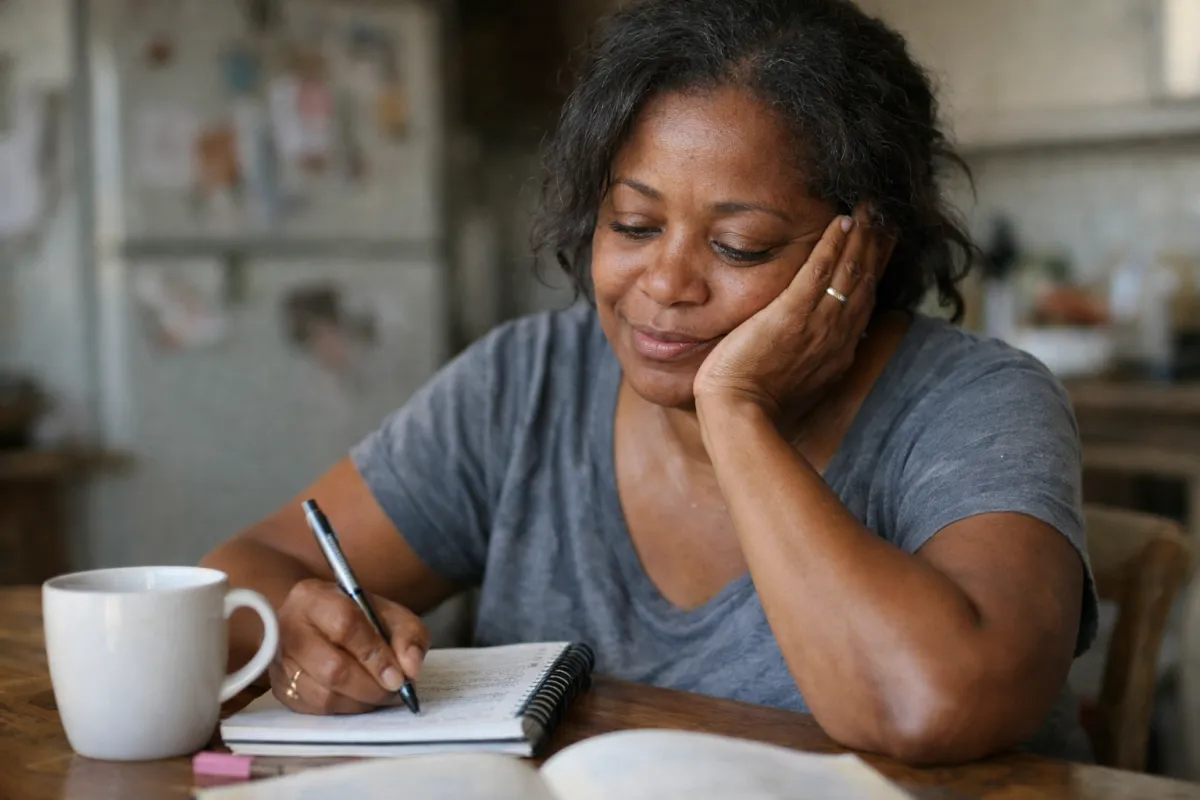
You’re Not Failing — You’re Learning
You’re Not Failing — You’re Learning: Motherhood Over 40
There’s a particular kind of exhaustion that comes from believing you should be doing better.
Not just tired from the night feeds and the endless demands — but tired from the weight of your own expectations. Tired from the gap between the mother you imagined you’d be and the mother you actually are on a random Tuesday at 3pm, still in yesterday’s clothes, wondering how everything became so hard.
I’m sitting here with my tea (lukewarm, naturally — it’s been one of those mornings), thinking about how much energy I’ve wasted judging myself for not having this all figured out yet.
If you’re a woman over 40 navigating early motherhood, you may know this exhaustion intimately. You may carry it alongside the nappies, the feeding schedule, and the mental load that never seems to lighten.
And beneath it all, a quiet voice whispers:
“You should be coping better than this. You’ve had decades to prepare. What’s wrong with you?”
Whether you’re in Bromley, Croydon, or anywhere in the UK, if you’re a mum over 40 feeling like you’re failing because this is harder than you expected — listen closely:
Nothing is wrong with you. You’re not failing. You’re learning.
And learning, at any age, is allowed to be difficult.
The Unfair Expectation Nobody Talks About
There’s an unspoken assumption that women who become mothers later in life should find it easier.
You’ve lived longer. You’ve built resilience. You’ve weathered challenges. You’ve navigated complexity.
Surely all of that should translate into competence at motherhood, right?
I believed this deeply.
When I became pregnant at 41, I thought: “Well, at least I’ve got life experience. I’ve managed difficult situations before. How hard can one tiny baby be?”
Oh, how wrong I was.
Early motherhood is not a test of accumulated wisdom. It’s its own country entirely — with its own rules — and everyone arrives as a beginner.
The woman who becomes a mother at 25 is learning. The woman who becomes a mother at 43 is learning.
The only difference is that older mothers often hold themselves to harsher standards.
Your life experience gives you resilience, perspective, depth — but it doesn’t exempt you from the learning curve.
And it certainly doesn’t mean you should judge yourself for being on it.
What Nobody Prepared You For
When Gabriel was born, I was 42. I’d spent decades being competent.
And suddenly I wasn’t.
Or at least, that’s how it felt.
Sleep deprivation wasn’t just tiredness — it was cognitive impairment.
I couldn’t remember words. I’d forget what I was doing mid-task. My ability to think clearly vanished.
Hormonal shifts were overwhelming.
Mood swings. Anxiety. Crying at adverts. Feeling fragile in ways I couldn’t explain.
Identity shifted overnight.
I wasn’t just adding “mother” to my life — I was integrating it into a life already full, already formed, already mine.
The mental load was relentless.
Feed times. Nappy changes. Appointments. Developmental milestones. Worrying about everything.
And through all of this, I was expected to cope. To be grateful. To cherish every moment.
No wonder I felt like I was failing.
I wasn’t failing. I was carrying an enormous amount.
The Comparison Trap (Especially Cruel for Older Mums)
Comparison hits differently when you’re over 40.
You compare yourself to:
younger mums who seem calmer
other mums who look more organised
your own imagined version of yourself
I thought I’d be more patient. More grounded. More emotionally regulated.
But motherhood doesn’t care about your expectations.
And the mother you imagined was based on incomplete information — she didn’t know about sleep deprivation, hormonal chaos, identity shifts, or the emotional labour of raising a small human.
You’re not behind. You’re simply in the middle of something harder than you expected.
And that’s allowed.
Reframing “Mistakes” as Learning
When you’re used to being competent, mistakes feel catastrophic.
But motherhood isn’t a performance. It’s a relationship.
And relationships are built through:
trial
error
repair
adjustment
presence
The day I lost my temper in the supermarket? That wasn’t failure — that was learning.
The nights I cried because I couldn’t settle Gabriel? Learning.
The moments I fed him toast for dinner because I was exhausted? Learning.
Learning looks like:
trying
adjusting
apologising
reconnecting
trying again
You’re not getting it wrong. You’re getting it gradually, imperfectly, humanly right.
The Voice in Your Head (And How to Challenge It)
Older mums often have a harsh inner critic.
Mine used to say: “You should be handling this better.”
Now I ask: “Is that true? Or is that pressure?”
Try replacing the critic with compassion:
Instead of: “I’m failing.” Try: “I’m learning.”
Instead of: “Other mums manage.” Try: “I don’t know their load. I only know mine.”
Instead of: “I should have it together by now.” Try: “There is no timeline. I’m finding my way.”
This shift changes everything.
What “Good Enough” Actually Means
There’s a concept in psychology: the good enough mother.
It doesn’t mean settling. It means recognising that perfection is not required for your child to thrive.
What your child needs is:
presence
responsiveness
repair
connection
Not flawless routines. Not perfect patience. Not constant calm.
When I lose my temper and apologise, Gabriel learns repair. When I show up imperfectly, he learns humanity. When I reconnect after a hard moment, he learns resilience.
Good enough mothering is not mediocrity. It’s relational strength.
And you’re already doing it.
Creating the Support You Need
You don’t need to have it together to ask for help.
Support looks like:
telling your partner the truth
asking a friend for dinner
joining a midlife mum community
working with a counsellor
letting someone else carry part of the load
You don’t need permission. You don’t need justification. You don’t need to prove you’re struggling “enough.”
You’re human. That’s qualification enough.
You’re Becoming (Not Behind)
Here’s what I want you to hold onto:
You’re not failing. You’re becoming.
Slowly. Imperfectly. One difficult day at a time.
Motherhood is not a destination. It’s a relationship you keep learning.
I’m five years in and still learning. Still adjusting. Still apologising. Still growing.
And that’s okay.
Be gentle with yourself. You’re carrying more than you realise. And you’re carrying it with more grace than you give yourself credit for.
You’re not failing. You’re learning.
FAQ — Learning vs Failing in Midlife Motherhood
Why do I feel like I’m failing when I’m doing my best?
Because your expectations don’t match the reality of early motherhood. Struggle is normal — not failure.
How do I stop being so hard on myself?
Speak to yourself the way you’d speak to a friend. Replace criticism with compassion.
Is it normal to feel overwhelmed even though I’m older?
Completely. Age gives perspective, not immunity from the learning curve.
Where can I find support in Bromley or Croydon?
Local groups may exist, but online communities like the Tea Break Sisterhood offer targeted support for mums over 40.
If motherhood over 40 feels heavier than you expected, you’re not failing — you’re human. And you don’t have to navigate this season alone. Connect with other midlife mums who truly get it inside the Tea Break Sisterhood — Mindful Tea Break®.
